A shadowy group is attempting to influence the future of Union County—not by promoting ideas, but by attacking public servants who stood up to powerful special interests.
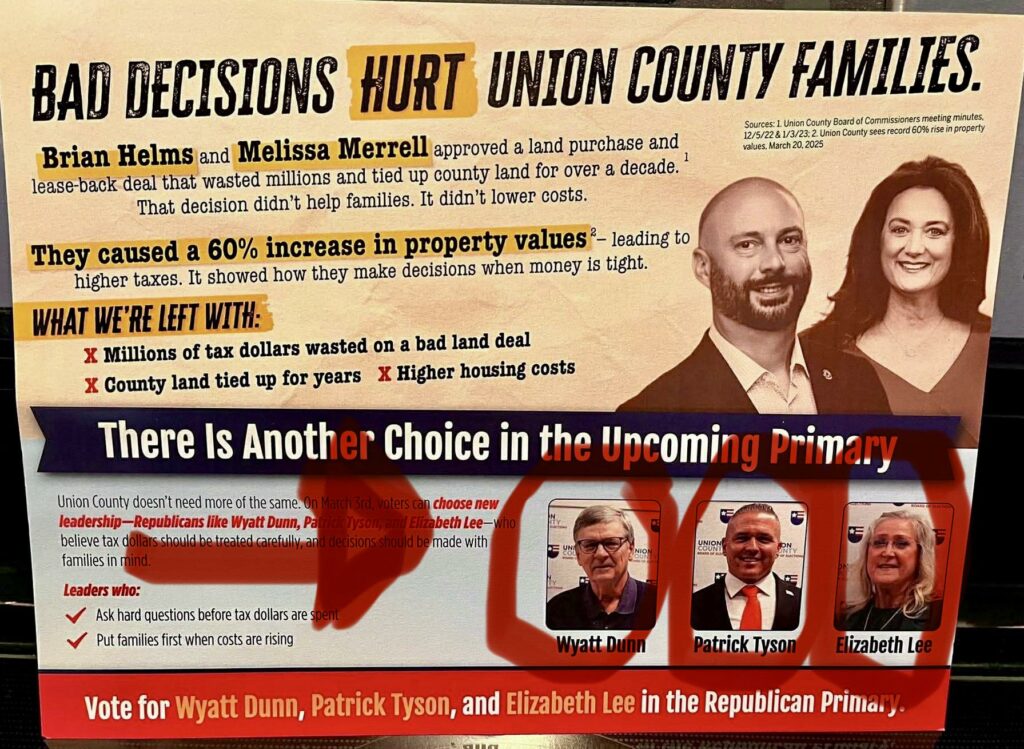
A recent television and digital ad, and a mass mailer, funded by Carolina Strong targets incumbent county commissioners Brian Helms and Melissa Merrell, accusing them of “reckless schemes,” “wasting millions,” and “locking up county land.”
These expensive ads never tell voters who to support. They simply attack.
This is how dark money works. Remember when this happened in Waxhaw?
Dark Money Enters Union County Elections
“Dark money” refers to political spending by organizations that do not fully disclose their donors. Groups organized as 501(c)(4) nonprofits can raise and spend money to influence elections without revealing who funds them.
That means Union County voters don’t know:
- Who is paying for the ads
- What financial interests they represent
- What policies they expect in return
Carolina Strong’s own website shows support for legislation like HB 765—legislation that would’ve rezoned all residential areas to a minimum of 6 houses per acre and removed zoning decisions from local governments statewide.
When local commissioners resist outside pressure, outside money attacks.
The Wastewater Plant They Voted Against
The ad claims Commissioners Helms and Merrell “signed off on a reckless county land scheme” and “wasted millions of taxpayer dollars.”
Here’s what actually happened:
- The day after the 2022 Primary Election, the previous outgoing board purchased the land under threat of condemnation from a local agricultural business, costing Union County jobs. No studies were completed and no out clauses were developed.
- Once sworn in, Helms and Merrell voted against moving forward with that plant, preventing the potential development of approximately 28,000 homes in Union County.
- To protect jobs, they supported a 10-year lease to the small business owner who had originally been pressured into selling the property.
- The North Carolina Department of Environmental Quality (DEQ) later ruled the land unsuitable for a wastewater treatment facility.
In other words: they opposed a massive taxpayer-funded project—and state regulators ultimately confirmed the site would not have worked anyway.
Calling that “reckless” turns reality upside down.
The Same Ad Everywhere
You’ll see in the accompanying screenshots:
- A banner ad on the WBTV website accusing Helms and Merrell of having “wasted millions on a land scheme.”
- The same ad appearing on the The Charlotte Observer website.
This wasn’t a one-off television spot. It was a coordinated digital ad buy across major Charlotte-area media outlets.
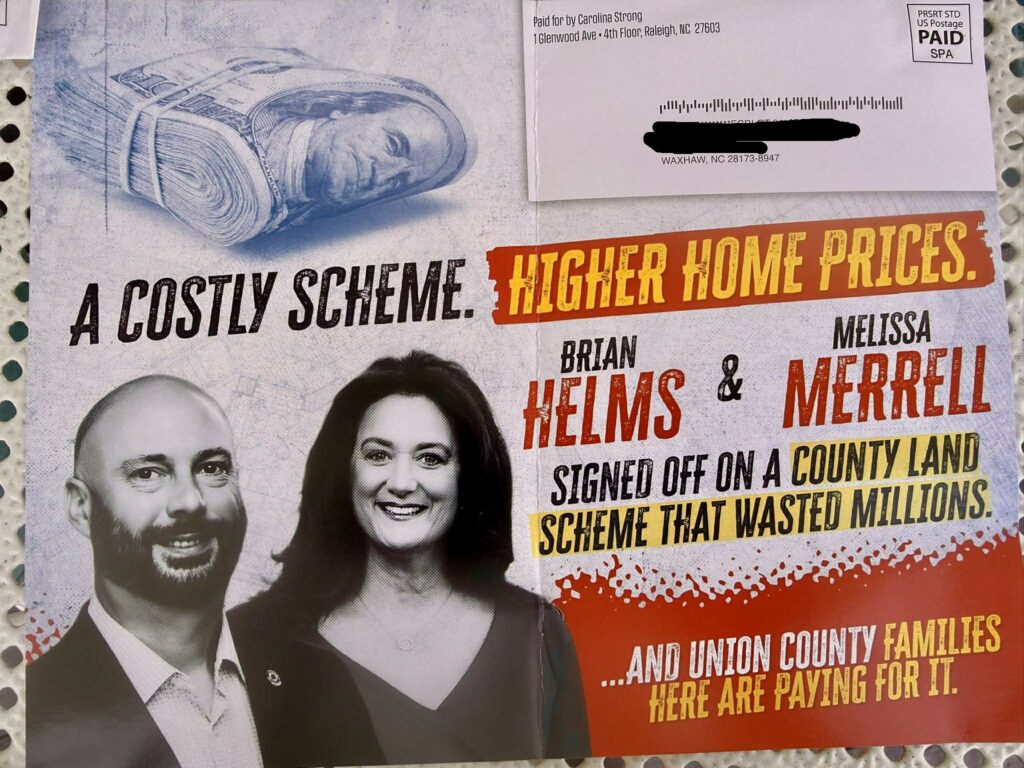
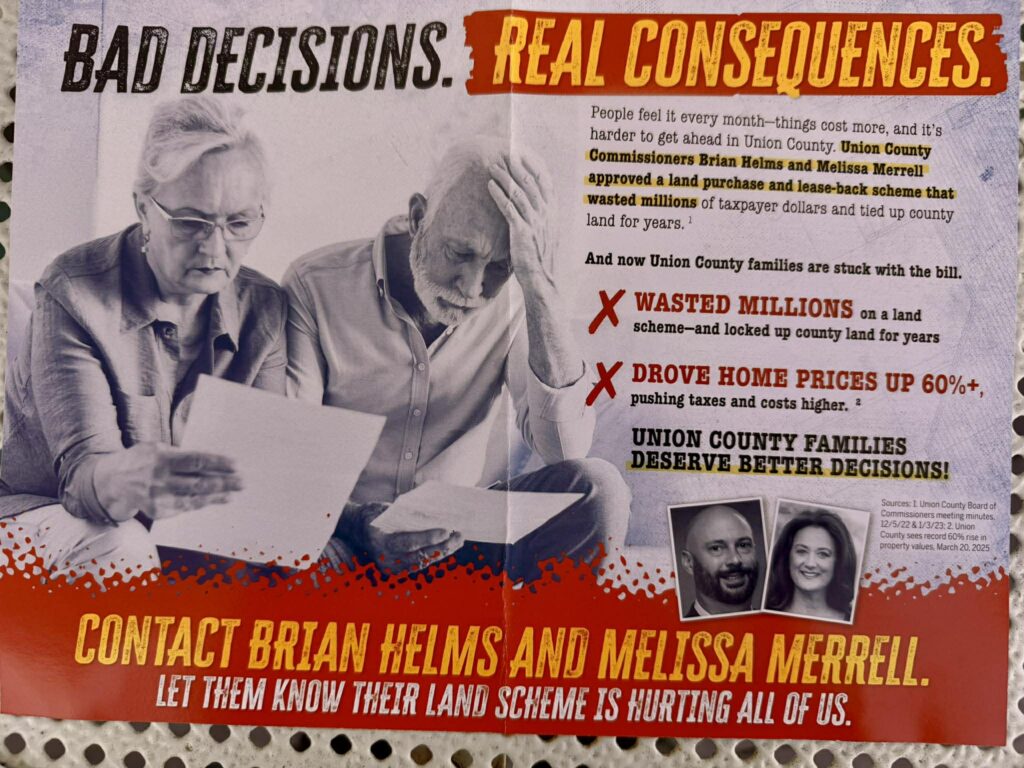
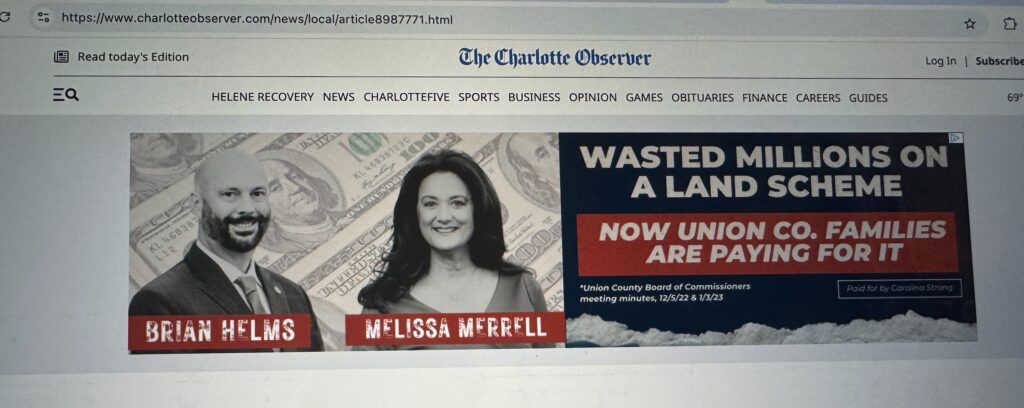
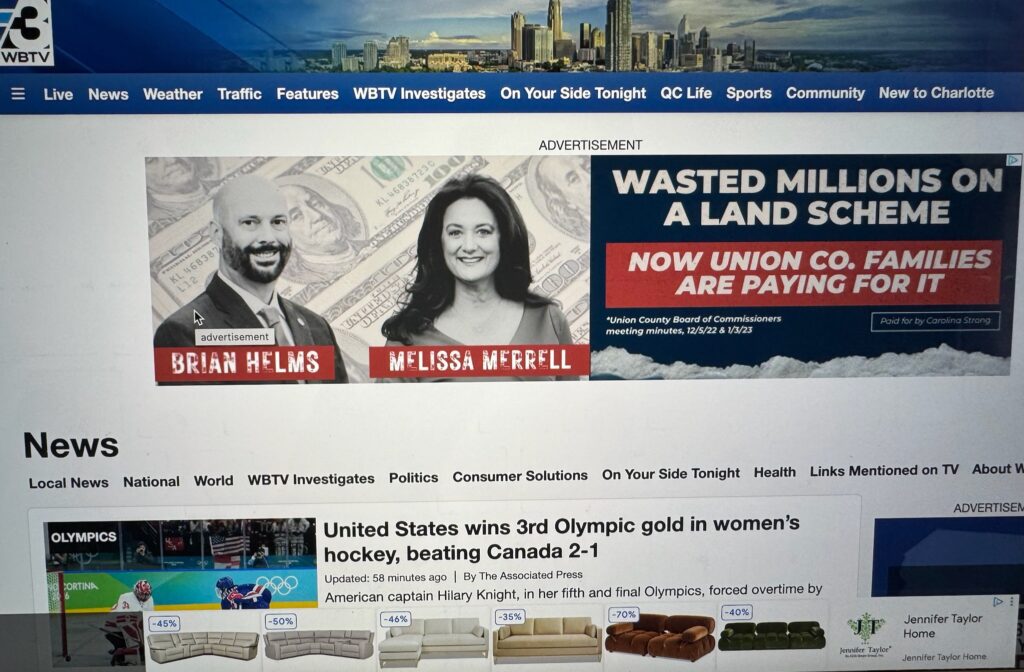
When the same anonymous-funded attack appears across multiple platforms, that’s not grassroots outrage—it’s a funded campaign. This kind of media blitz is normally seen only at the state and national level. Helms and Merrell have clearly stirred the ire of big money special interests.
The Tax Increase Claim — What the Numbers Actually Show
Another important piece of context missing from the attacks is the truth about taxes.
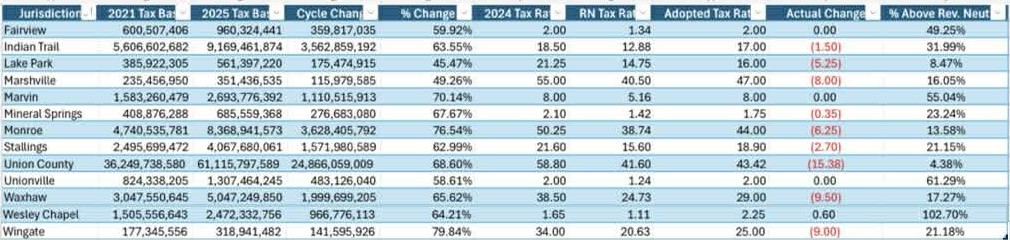
The accompanying tax comparison image shows:
- The percentage increase in county taxes was lower than every municipal increase across Union County.
- Municipalities raised taxes at higher percentage rates than the county did.
Even more important:
The county tax increase was primarily driven by the school bond approved by voters.
Residents voted for that bond.
They voted for the borrowing.
And repayment of that bond requires a tax adjustment.
In other words, voters effectively approved the increase.
Blaming commissioners for implementing what voters authorized is misleading at best.
It’s also worth noting that county staff initially proposed a larger tax increase. Brian Helms and Melissa Merrell pushed back and held the line to keep the increase lower than originally requested.
That’s not reckless spending.
That’s fiscal restraint.
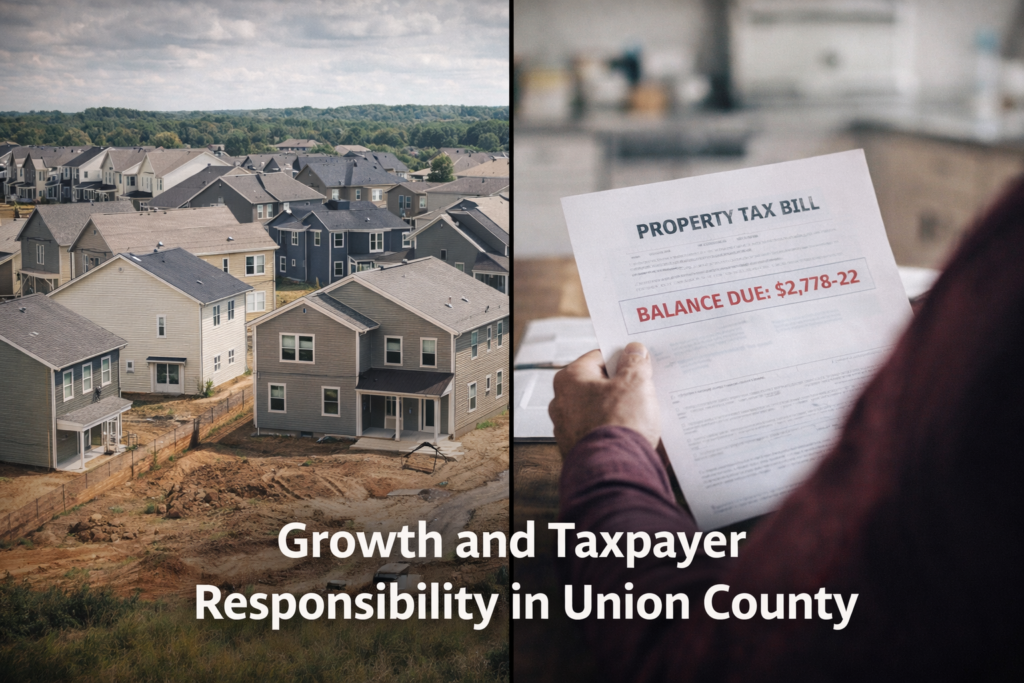
Who Pays for Growth?
The deeper issue behind these attacks isn’t land. It’s infrastructure.
Large-scale residential development requires:
- Wastewater capacity
- Road expansion
- Public safety expansion
- School capacity
Those costs can reach hundreds of millions of dollars.
The core policy disagreement is simple:
Should taxpayers subsidize infrastructure that primarily benefits private development?
Helms and Merrell have consistently taken the position that taxpayers should not be forced to finance infrastructure expansion simply to accelerate residential development.
That position has consequences—especially from those who profit from high-volume building.
The “Home Prices” Narrative
The ads also blame the commissioners for driving home prices up more than 60%.
This is a familiar talking point: build more houses and prices will fall.
But housing prices are influenced by:
- National interest rates
- Inflation
- Migration into the Charlotte metro area
- Construction material costs
- Investor demand
Suggesting two county commissioners caused a 60% increase ignores national economic forces.
Rapid construction financed by taxpayer-backed infrastructure does not automatically produce affordability. It produces supply. Affordability is far more complex.
Why Transparency Matters in Union County Politics
Union County residents deserve transparency in local elections.
If an organization wants to influence voters, it should:
- Disclose its donors
- State clearly which candidates it supports
- Engage honestly on policy differences
Instead, voters are seeing anonymous-funded attacks across television, major media websites, and in their mailbox, accusing sitting commissioners of “scheming” — despite the fact that they voted against a project that would have cost taxpayers hundreds of millions.
That contradiction alone should raise questions.
Follow the Incentives
When commissioners:
- Vote against massive infrastructure spending
- Resist taxpayer-subsidized development
- Keep tax increases lower than staff originally requested
… and are then targeted by a 501(c)(4) attack campaign,
Voters should ask:
Who benefits from removing them?
Dark money has a financial motive.
Union County Deserves an Informed Electorate
Local government decisions affect:
- Property taxes
- School funding
- Infrastructure spending
- Growth patterns
- Long-term debt
These are not small issues.
Union County deserves debate based on facts—not anonymous ads.
When voters see coordinated attacks funded by undisclosed donors, they should look deeper.
Because transparency is stronger than shadows.
And informed voters are stronger than dark money.