
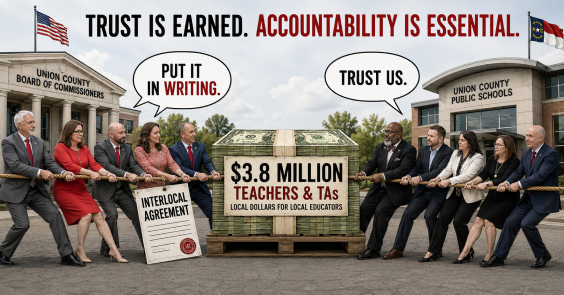
There is a growing rift between the Union County Board of Commissioners and the Union County Board of Education.
On the surface, the dispute is about an interlocal agreement and nearly $4 million in additional funding for Union County Public Schools.
But underneath it is something much more important:
Trust.
The UCPS Board of Education says the Union County Board of Commissioners should trust it to do the right thing with taxpayer money.
The county commissioners say trust was damaged by what happened last year, and they want a written agreement before releasing money specifically set aside for teachers and teacher assistants.
And when the BOE had the opportunity to accept that agreement, it said no.
That raises a pretty simple question:
If UCPS intends to spend the money exactly as promised, why is putting that promise in writing such a problem?
Nearly $4 million was set aside for teachers and TAs
The county’s proposed FY2026-27 budget contains two very different pools of additional money for UCPS.
The first is approximately $5.6 million in additional funding required under the state’s funding formula.
The second is approximately $3.8 million in additional local funding that the county placed in contingency specifically for teacher and teacher assistant supplements, subject to an interlocal agreement.
Those are not the same thing.
UCPS officials explained that much of the $5.6 million in additional operating funding is consumed by costs the school system cannot simply redirect, including mandated expenses, charter school payments, utilities, exceptional-children costs and other obligations.
The county’s separate $3.8 million contingency is different.
That money was specifically set aside to increase compensation for teachers and TAs.
At the June 16 BOCC meeting, a commissioner explained that the purpose of the agreement was to make sure both boards were “legally on the same page” about the intention of the funds. The commissioner emphasized that these were local dollars intended for local teachers and TAs.
So this isn’t a case of the county refusing to fund UCPS.
In fact, the county says it is providing more than the state’s required increase.
The county says it went beyond the state’s requirement
At the June 1 budget discussion, county officials pointed out that the state funding formula required approximately $5.6 million in additional UCPS funding.
The county’s actual proposed increase was approximately $8.8 million.
That’s roughly $3.2 million more than the state-required increase, before considering the separate $3.8 million contingency for teacher and TA supplements.
It is easy to look at a school budget dispute and conclude that the county is simply refusing to give schools enough money.
The numbers presented by the county tell a different story.
The county is funding the state-required increase and has separately identified additional local dollars for employee compensation.
The dispute is over the conditions attached to those additional dollars.
Why does the county want an agreement?
The answer goes back to last year.
In 2025, the county and UCPS had a very public disagreement over teacher supplements.
The county commissioners believed they were responding to a request to improve the compensation of classroom teachers, whose local supplement had fallen behind other districts.
UCPS is also competing for teachers in a regional labor market where compensation matters: state data show substantial movement of teachers among Charlotte-area districts, with UCPS recruiting 51 teachers from CMS in 2022–23, while a Charlotte Observer analysis found UCPS’s teacher turnover rate was higher than CMS’s. For experienced teachers, the competition extends across the state line as well, with South Carolina districts such as Fort Mill offering competitive salaries and provisions that can allow certain retired NC teachers to return to the classroom while retaining retirement benefits. UCPS is not operating in a vacuum: if Union County wants to retain its best teachers, it has to compete for them.
The BOCC agrees with these concerns and want to move classroom teachers up the rankings.
But the two sides apparently did not have the same understanding of what “teacher supplement” meant.
At the June 3 joint meeting, UCPS leadership explained that the term “certified staff” has historically encompassed more than classroom teachers. The local supplement has included other employees who are paid on the certified scale, including nurses, psychologists, counselors, social workers and other positions.
The superintendent acknowledged that the terminology had caused confusion.
He explained that when UCPS talked about a “teacher supplement,” it was historically referring to the broader certified-staff category. He even said he would have apologized for the misunderstanding had the issue been discussed at the time.
That is an important admission—not because it proves anyone acted improperly, but because it demonstrates exactly why the county now wants a written agreement.
Millions of dollars should not depend upon two boards having the same interpretation of a phrase.
The county says it asked for classroom teachers
The BOCC’s recollection of last year’s discussions is somewhat different.
One commissioner explained that the county had been approached about the relatively low ranking of Union County’s classroom teacher supplement. The county agreed that the compensation was too low and wanted to raise classroom teacher pay by $1,000 or potentially $2,000.
The commissioner then made an important point.
During the months of discussions, the BOCC says UCPS never came back and explained that the requested supplement increase was intended to include nurses, counselors, media personnel, psychologists, social workers, curriculum staff and others.
That disagreement over terminology is at the heart of the current distrust.
And it makes the BOCC’s desire for a written agreement considerably easier to understand.
This isn’t about controlling the school board
Several UCPS board members have characterized the county’s proposed agreement as an attempt to control the school board.
At the June joint meeting, the discussion included references to the county board being a “dictatorship,” along with repeated accusations that the agreement reflected a lack of trust.
But what exactly is the county asking for?
Not control of the school system.
Not control of curriculum.
Not control of hiring.
Not control of school assignments.
Not control of the superintendent.
The county is asking UCPS to agree that specific local dollars provided for a specific purpose will be used for that purpose.
That’s not control.
That’s accountability.
And there is nothing unusual about documenting an agreement between two governmental entities. At the June 16 meeting, a commissioner specifically noted that interlocal agreements between county commissioners and boards of education are not unusual in North Carolina.
“Trust us” is not a financial control
This is where the BOE’s argument becomes difficult to reconcile.
UCPS officials have repeatedly said they can be trusted to do exactly what the county wants.
At the June 3 meeting, a UCPS representative essentially put that assurance on the record: if the county allocated the money without an interlocal agreement, UCPS would provide teachers and TAs with the compensation represented by the proposed model, and the BOE could hold the superintendent accountable if it did not happen.
That’s reassuring.
But it doesn’t answer the question.
Why not put it in writing?
A written agreement doesn’t prevent UCPS from giving teachers raises.
It doesn’t prevent the superintendent from managing the school system.
It doesn’t prevent the BOE from exercising its authority.
It simply makes the commitment clear.
If everyone already agrees about what the money is for, signing the agreement should be relatively painless.
The line-item budget problem
There is another reason the county commissioners’ insistence on accountability deserves attention.
In recent years, UCPS has not provided the kind of detailed annual line-item budget that would allow the public to easily see how its local operating dollars are being spent.
This isn’t merely a complaint from outside critics.
At the June 16 BOCC meeting, a commissioner specifically asked county staff to communicate to UCPS that the county expects a line-item budget going forward, not only for the commissioners but for the public.
And during the June 3 joint meeting, the county asked UCPS for more detailed information about its personnel—particularly the distinction between state-funded and locally funded positions.
The response was revealing.
UCPS currently provides a monthly personnel report, but officials said they do not have an annualized report from that particular system. Staffing numbers change throughout the year because of funding changes, vacancies and state allocation revisions.
None of that necessarily means UCPS is doing anything wrong.
But it does demonstrate why the county is asking for greater transparency.
When you’re asking taxpayers to provide hundreds of millions of dollars, “trust us” is not a substitute for financial transparency.
The county has already learned that lesson
The BOCC has been unusually explicit about why it wants the interlocal agreement.
At the June 16 meeting, one commissioner said the agreement was a direct result of what happened the previous year.
“Trust is something that is hard to earn and easy to lose,” the commissioner said.
The agreement, he explained, was intended to begin rebuilding that trust “one step at a time.”
That is an important distinction.
The county isn’t saying:
“We don’t trust UCPS because we think you’re dishonest.”
It is saying:
“We had a major disagreement about what we understood you to promise last year, so this time we want the terms in writing.”
That’s a perfectly reasonable response to a breakdown in communication.
The irony is that the agreement should make no difference if everyone agrees
This may be the most important point in the entire dispute.
Suppose the BOE is right.
Suppose the county is overreacting.
Suppose UCPS genuinely intends to give teachers and TAs exactly the raises contemplated by the county.
Then signing the agreement should have essentially zero practical effect on UCPS.
The money would still be used for teachers and TAs.
The BOE would still control the school system.
The superintendent would still administer the budget.
Nothing fundamental changes.
The only thing the agreement does is document the commitment.
So why reject it?
And now teachers are caught in the middle
There is a frustrating irony here.
Everyone involved says they support teachers.
The county commissioners say they want to increase teacher compensation.
The BOE says it wants to increase teacher compensation.
The superintendent says teachers and TAs would receive the money even without an agreement.
Yet the two governing bodies cannot agree on the mechanism for delivering it.
That is precisely why taxpayers should want a clear agreement.
Teachers shouldn’t be caught in a political and bureaucratic dispute between two government boards.
They should receive the compensation both sides say they want them to receive.
And taxpayers should be able to see exactly where their money went.
The BOE ultimately chose another path
There is an important nuance here.
The BOE’s August 4 decision should not be characterized as simply voting against teacher raises.
The board rejected the interlocal agreement, but subsequently approved its own compensation plan—often referred to during the meeting as Option A—which included increases for teachers and teacher assistants.
So the issue isn’t whether the BOE supports teacher raises.
It says that it does.
The issue is whether the BOE was willing to accept additional county money under the conditions the county established for that money.
It wasn’t.
That distinction matters.
But it also makes the BOE’s rejection of the agreement more difficult to understand.
If the BOE’s plan is essentially what the county wanted to fund, why couldn’t the two boards simply document that agreement and move forward?
Transparency should not be partisan
There is a broader lesson here for both boards.
The county commissioners are responsible for appropriating taxpayer money.
The school board is responsible for operating the school system.
Neither board should expect the other to simply take its word for how millions of dollars will be spent.
The answer isn’t hostility.
The answer isn’t accusations of dictatorship.
The answer isn’t demanding blind trust.
The answer is transparency.
Put the terms in writing.
Provide a detailed budget.
Clearly identify the recipients of restricted funds.
Show taxpayers where their money goes.
Then there is nothing to argue about.
UCPS doesn’t need to be distrusted. It needs to be accountable.
There is no need to accuse UCPS officials of bad faith to support the county’s position.
There is no need to claim the BOE doesn’t care about teachers.
There is no need to suggest that every disagreement is evidence of corruption.
The facts presented by both boards provide a simpler explanation.
They had a serious misunderstanding last year over what “teacher supplement” meant.
The county believes that misunderstanding contributed to a breakdown in trust.
The county is now offering nearly $4 million in additional local money specifically for teachers and TAs, but wants a written agreement specifying its use.
UCPS says the agreement is unnecessary because the board can be trusted.
And UCPS has rejected the agreement.
At the same time, the county is pushing for a more detailed line-item budget and greater transparency from the school system.
The solution should be obvious.
Don’t rely on trust when accountability is available.
If UCPS intends to do exactly what the county is asking, sign the agreement.
If the county intends to provide the money it says it will provide, provide it.
And if both boards truly have the best interests of teachers, students and taxpayers at heart, they should welcome the transparency that makes everyone’s promises verifiable.
Trust is valuable.
But in government, accountability is better.