

Conservative decision-makers are a smart hedge against developer-driven decision-making
I attended a local town council retreat this past week and heard a familiar line from staff: developers will not be interested in commercial development until we have enough “rooftops.” (This means the staff is in favor of developer-driven high-density residential building!)
That line sounds practical. It is also one of the most frequently used talking points in the development playbook. It often becomes the town’s excuse for approving more and more high-density residential, while real commercial value, infrastructure, and quality of life lag behind.
So let’s talk about this for a moment. Let’s look at some statements that seem to be circulating in this voting primary season in Union County:
“You’re a Bigoted NIMBY!”
Reality: This is usually a cheap label meant to shut down debate rather than answer the real question. Wanting responsible growth, infrastructure that can handle new projects, and development that pays its own way is not “bigotry,” nor is it automatically NIMBY (not-in-my-backyard). Your town council’s job (and why they were elected) is to represent its current residents and taxpayers – the very people funding the roads, police/fire, parks, and services right now, not to rubber-stamp projects because a developer feels they should be able to build whatever they want.
“Retail follows rooftops.”
Reality: Sometimes. It is a real concept, but it is not a blank check for endless residential approvals. Just because there’s a bunch of rooftops, a business still chooses its location based on the numbers, the profit potential, the traffic, the access, demographics, costs, and competition.

“We just need more rooftops before commercial will come.”
Reality: If a town is already overwhelmingly residential, as many in Union County are, this becomes a convenient excuse. At some point, “more rooftops” stops being an explanation and becomes a permission slip for rezonings and developer-friendly practices.
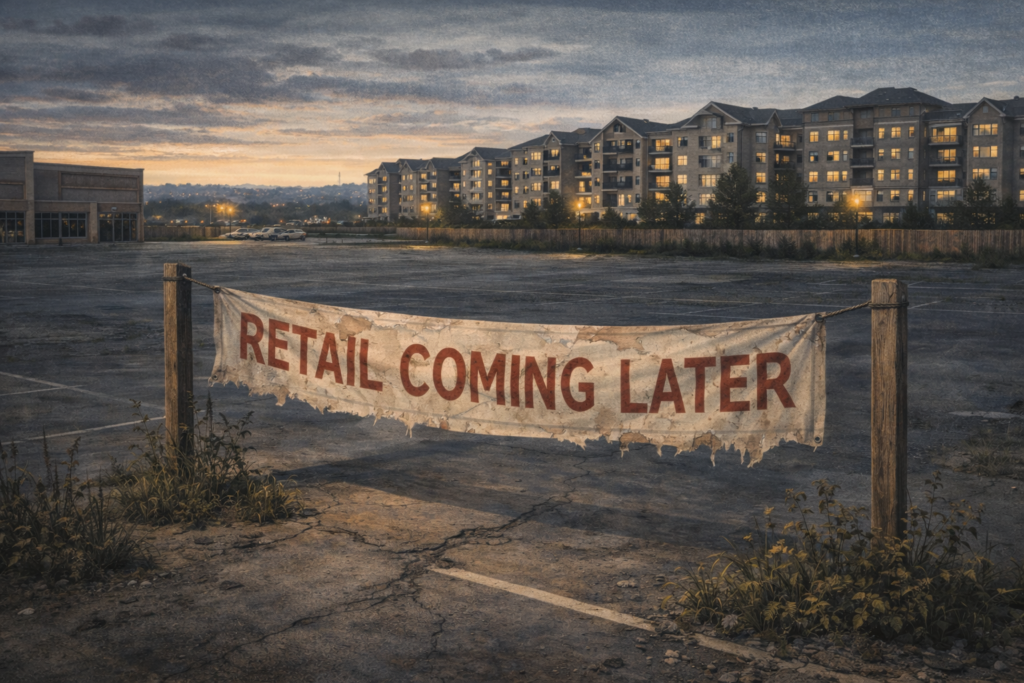
“Approve the high-density residential now, and the retail will come later.”
Reality: “Later” is not a plan. It is a promise that can always be postponed, especially after you have already rezoned the best commercial land to more high-density residential.
“Commercial will come when the market is ready.”
Reality: The market gets “ready” when fundamentals align. Retailers and employers care about visibility, traffic, access, household income, competition, land costs, permitting time, and whether the site actually functions. If those basics are off, you can add rooftops for a decade and still not land meaningful commercial.
“Housing is inevitable, so we might as well approve it.”
Reality: Growth is not a force of nature. Rezoning is a choice. Local boards are allowed to use discretion, set standards, and say no when a project is not in the public interest. Managed growth is a universal YES for most Union County families!
“If we do not approve this, we will get sued.”
Reality: This is a fear tactic that pressures town councils into rubber-stamping, and becomes the developer’s dream. The legal system is not designed to force towns to approve bad policy. “We might get sued” is not a growth strategy; it is a fear narrative.
“Density pays for infrastructure.”
Reality: Density increases demand for infrastructure. The question is not whether development produces revenue. The question is whether it produces enough revenue to cover the long-term costs it creates. Usually, it doesn’t, and the resident taxpayers are left to bear the tax burden.
“Apartments and condos are classified as commercial on the tax rolls.”
Reality: People say this to imply condos and apartments are some kind of fiscal jackpot. Taxes are based on assessed value and tax rates, not a magic label that turns this type of high-density into “free money.” It can generate revenue, but it also incurs costs: traffic, public safety calls, and school impacts at the county level. The honest question is: Does it pay for itself, or do existing residents subsidize it?