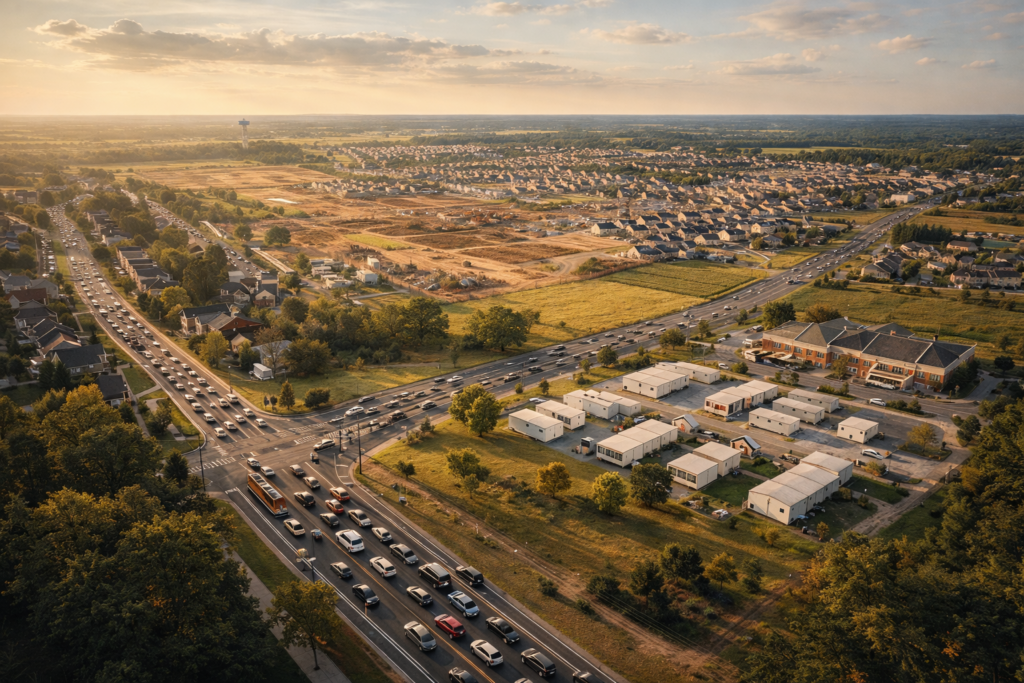

If you want to put the brakes on developer-driven growth in Union County, conservative decision-makers are the answer.
Lately, we are being told to absorb growth while developer-first approvals stack more demand on the same roads, the same schools, and the same public safety resources.
Here’s the part that rarely gets said out loud:
They can label it “progress” or “growth” all day. But we are absorbing the costs, with a lower quality of life reflected in our bills, our roads, and our schools.
Sometimes the cost is a tax increase.
It might be your 45-minute commute that used to be 15 minutes.
Sometimes it’s your child eating lunch at 10:00 a.m. because the cafeteria schedule is maxed out.
Sometimes it’s a school “solution” of mobile trailers that adds classrooms but doesn’t provide the systems a school needs to function, such as bathrooms, cafeterias, libraries, bus capacity, counselors, parking, or safe pickup lines. Or enough playground swings.
If you feel like you are being told the burden is imaginary, you are not imagining it. You and your family are absorbing it.
Now’s the time to make some changes – it’s primary season in Union County. Make your voice heard this time!
When developer-friendly approvals outpace infrastructure, residents absorb the impact in very real ways:
- Your wallet: higher taxes, higher fees, more bonds to pass, bigger budgets, bigger gaps. Everywhere.
- Your time: worse traffic, longer school bus routes, long waits, slower emergency responses. All the time.
- Your kids’ schools: packed classrooms, maxed cafeterias, bathroom crowding, strained staffing, and lack of buses. Each school day.
- Your quality of life: longer work commutes, unsafe roads, more noise, and less land. Less of what makes Union County sweet. Less family time.
What we’re living through is burden transfer. A polite term for: someone else wins, and you pay.

Burden transfer can play out like this: developers get fast approvals and a predictable path to profit, while the rules box in local control and shove the costs downstream to taxpayers.
Residents pay the tab through higher taxes, lost time, crowded schools, and stretched public safety. Absorb it or get out.
If we do not call it what it is, burden transfer, the story stays backwards: residents asking for responsible planning get smeared, and the people rubber-stamping approvals get labeled “pro-business.” A form of civic gaslighting.
Most Union County families aren’t saying “no.” They’re saying “yes” with responsible standards. They are saying:
Yes, when it pays its way.
Yes, when infrastructure is ready.
Yes, when approvals come with enforceable, phased, measurable commitments.
Here’s the real truth:
You’ll hear that “growth pays for itself.” But the fiscal impact of development tells a different story when infrastructure costs are deferred.
Reality: If policy doesn’t require the full costs to be covered, the bill lands on residents through higher taxes, service cuts, and lower quality of life. “Tax base” is not the same thing as net fiscal benefit. Developers win and walk away, leaving us holding the bag.
How it plays out:
- Roads are not upgraded up front, so we sit in traffic now and pay for widening later.
- School impacts get minimized, so taxpayers end up funding the school expansions.
They will tell you: “We can’t make developers wait. Infrastructure always catches up later.”
Reality: “Later” is just a nicer way of saying “residents will absorb it.” Concurrency means building roads, sewer, and school capacity alongside growth. Basic rule: do not put thousands of new people into systems that are already maxed out.
Concurrency planning means roads, schools, and utilities are in place before new residential density is approved.
Without concurrency planning, growth does not pay its way — taxpayers become the backstop.
How it plays out by adopting concurrency:
- Concurrency prevents adding housing while schools are already at capacity.
- Concurrency prevents approving residential density while roads are stressed and intersections are unsafe.
- Concurrency prevents green-lighting projects based on pie-in-the-sky improvements that are neither funded nor scheduled for delivery!
They will tell you: “Staff already reviews it. Developers provide studies. We have enough information.”
Reality: Developer-funded studies usually answer the question they’re paid to answer. Staff reviews often check minimum-compliance checkboxes, rather than whether the deal works for taxpayers in the long term or fits the character of the community. Independent studies are how we stop being the default subsidy, the sponge that absorbs overgrowth.
How it plays out:
- Simply put, infrastructure upgrades are needed. Who will pay, and what will the real costs and day-to-day impacts be for the current residents?
They will tell you: “Building in stages, one phase at a time with checkpoints or triggers will slow growth and hurt housing supply.”
Reality: Building in stages and using capacity checkpoints don’t stop housing. They stop reckless timing. Without clear no-fixes, no-next-phase rules, residents absorb the impacts first, and the promise of school improvement becomes optional later. That isn’t planning. That’s allowing developers to build first and fix later – on our dime.
How it plays out:
- Phase 1 gets approved and built.
- Improvements get delayed because “conditions changed.”
- Phase 2 gets approved anyway.
- Residents continue to absorb the burden through traffic, strained services, and overcrowded schools.
They will tell you: “We hear you. We’ll work on it. It’s complicated.”
Reality: If they cannot name specific actions with deadlines, the plan is simple: you absorb it. They are not the experts on your money; you are.
Are you sick of absorbing costs and the burden transfer?
Growth that does not pay its way is not growth. It is a bill. For you to pay.
In Union County, families are not anti-growth. They are pro–responsible growth that protects quality of life. They want development that pays its way instead of transferring the burden to taxpayers.